
Lumbosacral and brachial plexus maps
Brachial & Lumbosacral Plexus — “The London Map” Series

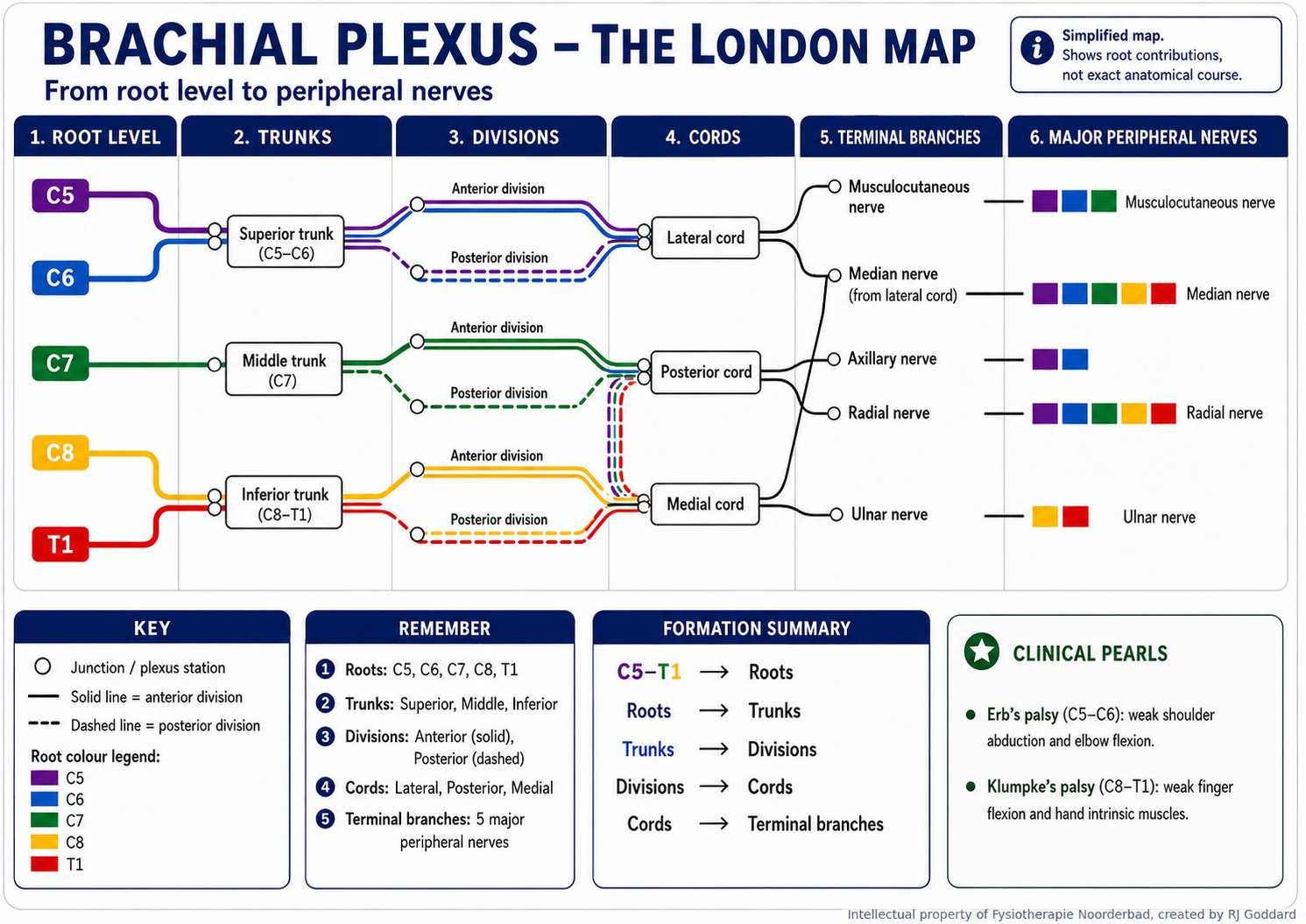
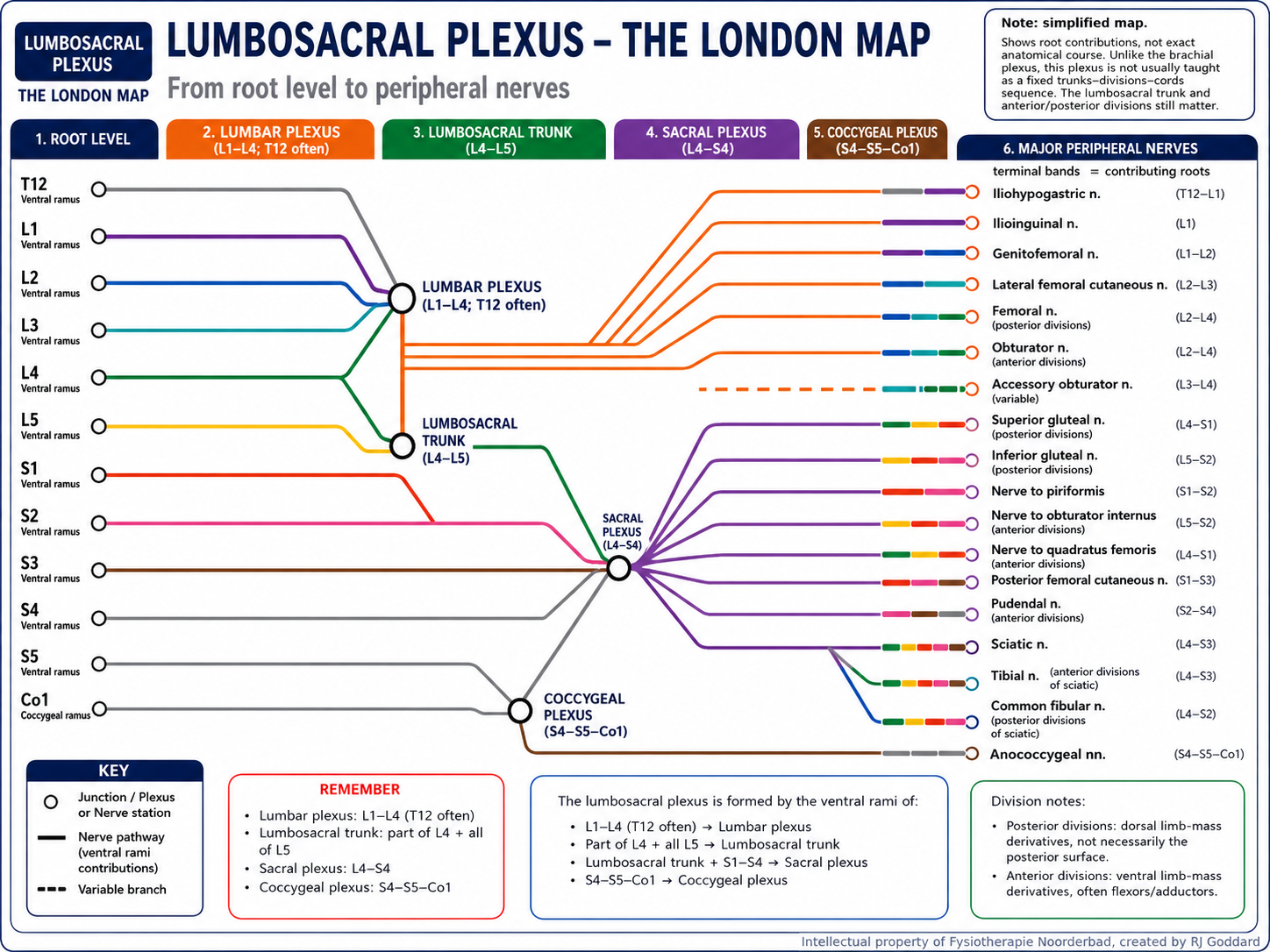
During teaching the Peripheral Neurology block for first-year physiotherapy students at Hanze University of Applied Sciences, I found myself repeatedly looking at conventional brachial plexus diagrams online. While useful, many of them were visually dense and difficult for students to follow during early neuroanatomy teaching.
At some point it struck me that the structure of the plexuses resembles an underground transit system: roots merging into trunks, divisions separating, and peripheral nerves branching out like railway lines.
Being English, there was only one logical design inspiration.
These illustrations are my attempt to reimagine the brachial and lumbosacral plexuses in the style of a London Underground-style transit map — simplifying complex anatomy into something that is hopefully easier to visualise, remember, and teach.
These diagrams were created primarily as educational tools for physiotherapy students, but they are free to use for:
- students
- teachers
- lecturers
- therapists
- educational presentations
You are welcome to share them, use them in teaching materials, or place them on your own website, provided that:
- proper credit is given, and
- a link back to the original source is included.
Created by:
Robert Goddard
Fysiotherapie Noorderbad
Groningen, The Netherlands
London Underground-inspired design. Not affiliated with or endorsed by Transport for London.
Concept, anatomical structure, educational design, and iterative refinement by Robert Goddard. AI-assisted visual generation used during development.
Update 25-5-26: while looking for ideas for an upcoming lesson, I stumbled across a 13-year-old blog, it seems I’m not the first to notice the resemblance and in the spirit of credit where credit is due, here is the link to that post
Would you like to read more about complaints of arm neck and shoulder? Check out our arm, neck and shoulder hub.
More interested in reading about spine related problems? We’ve got you covered there too, check out our spine hub.